Signals
If the first line does not match the signal, do not send it
Intent-based outbound messaging means the first line matches the signal. Generic first lines fail. Gong, as cited: 3.4% email reply, 2.3% call to meeting.
August 27, 2026
If the first line does not match the signal, do not send it
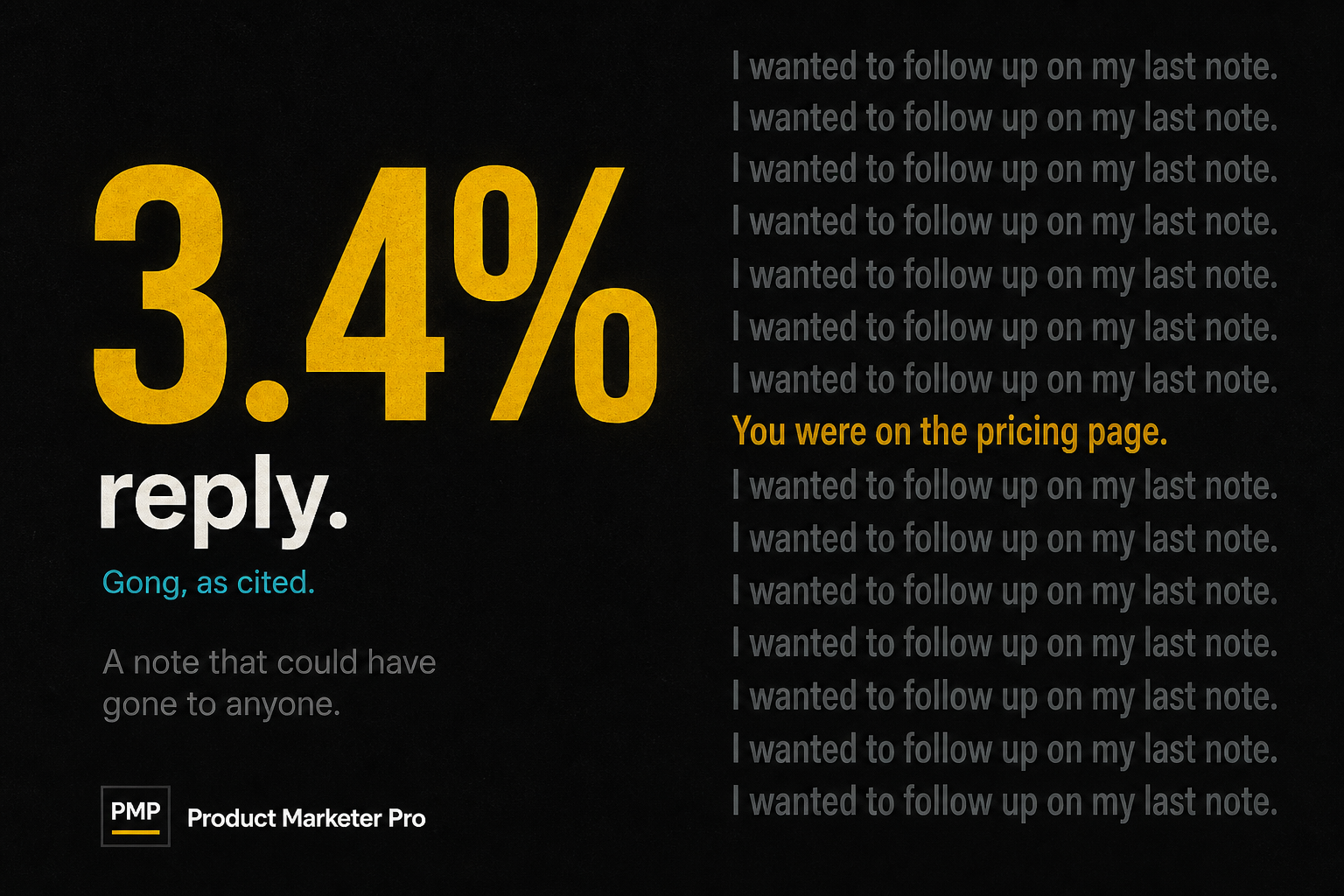
Intent-based outbound messaging is a first line that only makes sense because of the signal you saw. Pricing page. G2 category. Competitor LinkedIn. A first line that could have gone to anyone fails because Gong, as cited, puts cold email replies at 3.4% and cold call to meeting at 2.3%.
This isn't a copy problem. This is a mismatch problem.
I keep seeing the same send.
Congrats on the new role. Saw you were hiring. Loved the post. Quick question, do you have 15 minutes.
That note could have gone to anyone. So it does not go.
A pricing-page visit is not a new-job template. Gong, as cited, already priced the spray: 3.4% replies, 2.3% of cold calls become meetings.
What is intent-based outbound messaging?
It is outbound where the first line is proof you saw the signal. Not a merge field. Not a job-change list with a different first name.
The account hit your pricing page. Or they were on your G2 category. Or they commented on a competitor's LinkedIn. That is the list. The message has to match what they actually did.
If you cannot point at the signal in the first line, you are not doing intent-based outbound. You are doing spray with better adjectives.
By ignoring the signal, you ignored the only reason they would read you.
Why do generic first lines fail?
Because the market already trained itself to delete them.
Gong, as cited: 2.3% of cold calls become meetings. 3.4% of cold emails get a reply. That is not a personalization gap you close with "noticed you're in Austin." That is what happens when the first line could have gone to anyone.
Now some of you are thinking: I just need more volume. More sequences. More seats on the dialer.
No. Pushed meetings convert under 12%. Timeline-qualified convert at 35%+. Sales analytics platforms, as cited. You can force a cold "not interested" onto a calendar. You will pay for it in ghosting.
The generic first line is how you manufacture the 12%.
I hate talking about problems without discussing solutions. The fix is not a warmer opener. The fix is a first line that could only have been written if you saw the signal.
What signals should a SaaS founder actually write to?
Job change is a signal. It is not the motion.
Write to what they did, not what a list vendor says they are.
Website de-anon. Vector, RB2B, tools like that. Who was on the site, which pages, how recent. A pricing-page visit and a careers-page visit are not the same person, and they are not the same note.
G2. Which companies are on your category page and your competitor pages. They are already running the comparison. Talk the comparison.
Competitor LinkedIn. People who comment or reply on a competitor post. That is a hand-raiser. A purchased title is not.
If they are not in the ICP, do not outbound them. Change who you attract. Do not write a clever first line to the wrong account.
How do I match the first line to the signal?
One test. Could this first line have gone to a different account with a different signal. If yes, delete it.
If they were on pricing, then you talk the decision on that page. Seats. Usage. The plan they hovered. You do not send the new-job template.
If they were on a competitor G2 page, then you talk the comparison they are already running. You do not send "saw you're a VP."
If they engaged a competitor post, then you talk the problem in that post. You do not send a 4-paragraph sequence.
The core claim does not change every week. Who it is for, why it matters, how you are different. That stays. The entry point changes.
AI drafts the first line from the signal. I still own the claim. The model is the operator, not the strategy. Hand it the strategy and you get a note that could have gone to anyone, faster.
If the first line works on all three signals, then you do not send it.
What does the discovery, enrichment, first-touch loop look like?
Discovery. Pull the signals on a cadence. Site visitors. G2. Competitor social. Not a purchased job-change dump.
Enrichment. Company, role, in ICP or not, what they touched, when. AI does the grind. A human kills the junk.
First touch. One note that could only have been written if you saw the signal. Then you send it. If the first line does not match, you do not send it.
So basically the whole motion is: see the thing, name the thing, write the thing. Sequences without a signal are how you train the market to ignore you.
In hindsight the job-change spray was always a volume trick. It looked like intent because a title moved. Titles move all year.
Would you rather send 1,000 notes that could have gone to anyone, and live inside Gong's 3.4%? Or send the 40 that match the page they were on?
It is really that simple at this point.
If the first line could have gone to anyone, it does not go. Gong already published the receipt: 3.4% and 2.3%.
FAQ
What is intent-based outbound messaging?
It is a first line that matches the signal you actually saw. Website de-anon, G2, competitor LinkedIn. If you could send the same first line to a stranger with a different signal, it is not intent-based.
Why do generic first lines fail on cold email?
They fail because they prove you did not see anything. Gong's 2.3% call-to-meeting rate and 3.4% email reply rate, as cited, are that filter, measured. More volume on the same first line does not fix it.
Is a job change enough of a signal for outbound?
No. Job change is one signal. It is not the motion. Treat it as a weak input, not the list you build the week around.
Where does AI belong in intent-based outbound?
AI drafts, scores, and enriches. You still decide who is in market and what the claim is. If the model writes a first line that could have gone to anyone, you kill it. The model is the operator, not the strategy.
What if I do not have website de-anon yet?
Then you still do not spray. Start with G2 and competitor LinkedIn, which are public. A smaller list with a matching first line beats a big list of job changes.
What happens if I push a mismatched meeting anyway?
Pushed meetings convert under 12% vs 35%+ for timeline-qualified, per sales analytics platforms as cited. That gap is the bill for sending the wrong first line and then arguing them onto the calendar.
The rest of Signals is the first line plus the loop. Discovery, enrichment, first touch. I teach it inside Convert.
Frequently asked questions
- What is intent-based outbound messaging?
- It is a first line that matches the signal you actually saw. Website de-anon, G2, competitor LinkedIn. If you could send the same first line to a stranger with a different signal, it is not intent-based.
- Why do generic first lines fail on cold email?
- They fail because they prove you did not see anything. Gong's 2.3% call-to-meeting rate and 3.4% email reply rate, as cited, are that filter, measured. More volume on the same first line does not fix it.
- Is a job change enough of a signal for outbound?
- No. Job change is one signal. It is not the motion. Treat it as a weak input, not the list you build the week around.
- Where does AI belong in intent-based outbound?
- AI drafts, scores, and enriches. You still decide who is in market and what the claim is. If the model writes a first line that could have gone to anyone, you kill it. The model is the operator, not the strategy.
- What if I do not have website de-anon yet?
- Then you still do not spray. Start with G2 and competitor LinkedIn, which are public. A smaller list with a matching first line beats a big list of job changes.
- What happens if I push a mismatched meeting anyway?
- Pushed meetings convert under 12% vs 35%+ for timeline-qualified, per sales analytics platforms as cited. That gap is the bill for sending the wrong first line and then arguing them onto the calendar. The rest of Signals is the first line plus the loop. Discovery, enrichment, first touch. I teach it inside Convert. Start Convert