Signals
Job change is a signal. It is not the motion
Job change is a signal, not the motion. 95% of B2B buyers aren't in market (Ehrenberg-Bass / LinkedIn B2B Institute). Use site, G2, and competitor LinkedIn.
August 27, 2026
Job change is a signal. It is not the motion
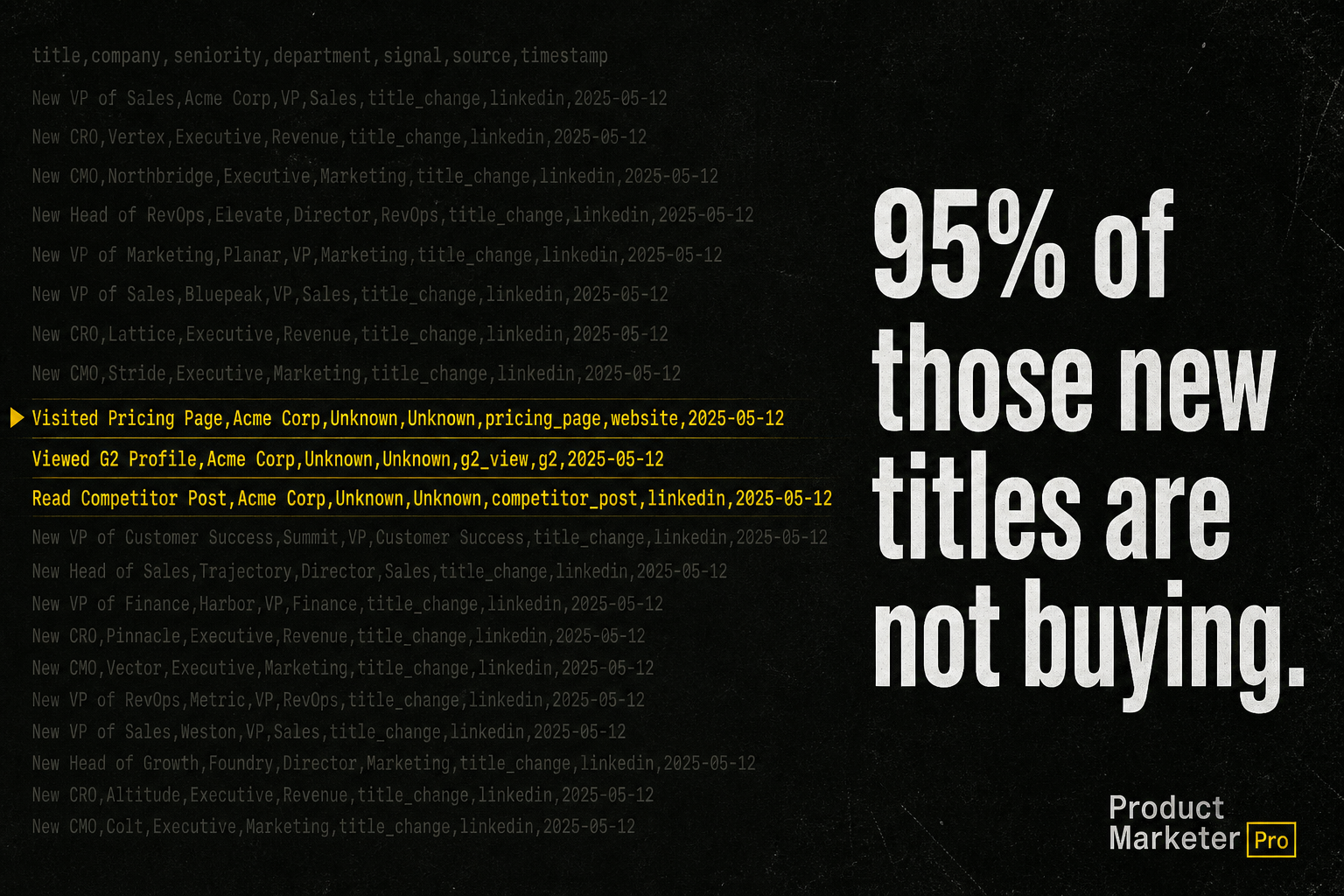
Job change is a signal. It is not the motion. Buyer intent signals that matter in 2026 beyond job change: unmasked site visits (Vector, RB2B), companies on G2 competitor pages, and people engaging competitor LinkedIn. A purchased title is not a hand-raiser.
I keep watching founders and GTM teams buy the same list.
New VP. New CRO. New Head of Marketing. Congrats on the role. Then a 14-touch sequence that could have gone to anyone.
Ehrenberg-Bass, writing for the LinkedIn B2B Institute, put a number on why that fails. At any moment, about 95% of B2B buyers are not in market. About 5% are. Companies change providers (banks, law firms, software) on cycles measured in years. In a given quarter, most of your ICP is not buying.
A job title in a purchased list is not a hand-raiser when 95% of B2B buyers aren't even in market (Ehrenberg-Bass / LinkedIn B2B Institute).
Why isn't job change enough for outbound in 2026?
CAC is the highest it has been in my career. You cannot buy your way out with more undifferentiated outbound.
Outbound still works. Anyone telling you it died is not being honest with you. The volume and the personalization required are ugly. If you cannot do both, the sequence is how you train the market to ignore you.
Job-change lists are cheap to buy and easy to sequence. That's why everyone runs them. That's also why they stopped working as a motion.
A new title might mean they have budget. It might mean they inherited a mess. It might mean they have 90 days of "let me learn the stack" and zero interest in your demo.
You don't know which. The list doesn't tell you.
By treating every job change like a hand-raiser, you ignored the 95%. You spent the SDR's week on people who were never going to buy this quarter.
This isn't a list problem. This is an in-market problem.
95% of your ICP is not buying. Stop talking to them like they are.
What buyer intent signals actually matter besides job change?
I hate talking about problems without discussing solutions. Here's the stack I want you to run.
Job change can sit in the stack. It does not lead the stack.
The signals that leak intent:
Website de-anon. Vector, RB2B, and tools like them. Who was on the site, which pages, how hot. A pricing-page visit is not the same as a blog skim. You pick a tool. You decide the filter.
G2. Which companies are on your category page and on competitor pages. They are already running a comparison. That is closer to a buying window than a title you bought on Monday.
Competitive social. People who comment, reply, or otherwise engage on a competitor's LinkedIn. That is a hand-raiser. A job title in a purchased list is not.
Direct traffic quality matters. If you unmask the site and it is not the ICP, do not outbound them. Change who you attract. Do not write a better note to the wrong crowd.
Build a simple score: in ICP, signal type, recency, page or post they touched. AI can rank. You set the rules. The model is the operator, not the strategy.
This isn't a dashboard you buy from me. This is a loop you run with tools you already have, or can rent this week.
How do I match the first email to the intent signal?
The message has to match the signal.
If they were on the pricing page, you do not send the "congrats on the new role" template.
If they were on a competitor G2 page, you talk the comparison they are already running.
If they engaged a competitor post, you talk the problem that post is about.
If the only thing you know is they changed jobs, you have a greeting, not a reason.
Now some of you are thinking: wait, isn't that just more personalization theater?
No. Personalization theater is a first line that names their company and still could have gone to anyone. A note that could only have been written if you saw the signal is the opposite.
Would you rather send 1,000 job-change emails into the 95%, or 40 notes to people who were on a competitor's G2 page this week?
I know which one books meetings.
AI drafts the first line from the signal. You still own the claim. If the draft could sit in anyone's inbox, you cut it.
What's the workflow from a buying signal to first touch?
Four steps. Discovery, enrichment, first touch, outbound.
Discovery: pull the signals on a cadence. Site visitors from Vector or RB2B. Companies on G2 competitor pages. People engaging competitor LinkedIn. Daily if you have volume. Weekly if you don't. Do not wait for a quarterly list refresh from a vendor who sold you titles.
Enrichment: company, role, whether they are actually in the ICP, what they touched. AI does the grind. A human kills the junk. If they are not in the ICP, they do not go to outbound. Signal without fit is still a waste.
First touch: one note that could only have been written if you saw the signal. Not a 4-paragraph sequence. Not "saw you're hiring" copied 400 times. One claim. One receipt. One ask.
Outbound: volume is real. Personalization is required. Sequences without a signal are how you burn the domain and then blame "outbound" when the 95% does what the 95% always does. They ignore you.
If this, then that.
If you have a pricing-page visit from an ICP account, then write to the page, not the title.
If you have a G2 competitor-page hit, then write the comparison. Do not write a brand story.
If you have a competitor LinkedIn engager, then write to the problem in that thread.
If all you have is a purchased job change, then you do not have a motion. You have a maybe. Park it. Do not spend the week's sends on maybes.
Does outbound still work when most buyers are not in market?
Yes. Outbound still works.
What does not work is treating a purchased title as the whole motion and hoping volume covers the miss rate.
You either figure out who is in the 5% and write to the signal, or you keep paying CAC for conversations that were never going to close.
It is really that simple at this point.
The Signals module inside Convert, Signals, Grow is this loop. Intent that matters, a message that matches, a workflow you can run this week. Convert is still who / why / how. Grow is spend, after the loop works. Signals is the 2026 work most teams skip because the job-change CSV is sitting in the inbox and it feels like progress.
It isn't. 95% of those rows are not in market (Ehrenberg-Bass / LinkedIn B2B Institute).
FAQ
Is a job change a buying signal?
It is one signal, not a buying window. A new title can mean budget, chaos, or 90 days of watching. Ehrenberg-Bass, for the LinkedIn B2B Institute, says about 95% of B2B buyers are not in market at any moment, so treat job change as a flag, not a motion.
What buyer intent signals matter more than job change in 2026?
Unmasked site visits (Vector, RB2B, and tools like them), companies on G2 competitor pages, and people engaging a competitor's LinkedIn. Those are things a buyer did. A purchased job title is a thing a vendor sold you. The first group is closer to the 5% who are actually in market.
Why don't purchased job-title lists convert?
Because 95% of your ICP is not buying (Ehrenberg-Bass / LinkedIn B2B Institute). A list of new VPs is mostly people who are not in market. You paid for fit, not timing, and fit without timing is how you burn the domain.
How should the first email change based on the signal?
Match the message to the thing they already did: pricing page means price, G2 competitor page means the comparison, competitor LinkedIn means the problem in that post. Job change only is a greeting, not a reason. Don't send the greeting at volume.
Do Vector and RB2B replace outbound?
No. They are examples of how you find who hit the site, not a replacement for outbound. You still enrich, filter for ICP, and write the first touch. A Slack alert is not a pipeline.
What is the 95/5 rule in B2B, and what should I do with it?
At any moment, about 95% of B2B buyers are not in market and about 5% are (Ehrenberg-Bass / LinkedIn B2B Institute). Stop sequencing the 95% like they raised a hand. Find the 5% through real intent (site, G2, competitor social), then write a note that could only exist if you saw the signal.
CTA
Start Convert.
Frequently asked questions
- Is a job change a buying signal?
- It is one signal, not a buying window. A new title can mean budget, chaos, or 90 days of watching. Ehrenberg-Bass, for the LinkedIn B2B Institute, says about 95% of B2B buyers are not in market at any moment, so treat job change as a flag, not a motion.
- What buyer intent signals matter more than job change in 2026?
- Unmasked site visits (Vector, RB2B, and tools like them), companies on G2 competitor pages, and people engaging a competitor's LinkedIn. Those are things a buyer did. A purchased job title is a thing a vendor sold you. The first group is closer to the 5% who are actually in market.
- Why don't purchased job-title lists convert?
- Because 95% of your ICP is not buying (Ehrenberg-Bass / LinkedIn B2B Institute). A list of new VPs is mostly people who are not in market. You paid for fit, not timing, and fit without timing is how you burn the domain.
- How should the first email change based on the signal?
- Match the message to the thing they already did: pricing page means price, G2 competitor page means the comparison, competitor LinkedIn means the problem in that post. Job change only is a greeting, not a reason. Don't send the greeting at volume.
- Do Vector and RB2B replace outbound?
- No. They are examples of how you find who hit the site, not a replacement for outbound. You still enrich, filter for ICP, and write the first touch. A Slack alert is not a pipeline.
- What is the 95/5 rule in B2B, and what should I do with it?
- At any moment, about 95% of B2B buyers are not in market and about 5% are (Ehrenberg-Bass / LinkedIn B2B Institute). Stop sequencing the 95% like they raised a hand. Find the 5% through real intent (site, G2, competitor social), then write a note that could only exist if you saw the signal.